







In Hong Kong, where life moves fast and kitchens are compact, the sink can feel like a battlefield after dinner. Many of us have had the same thought: "Why load a dishwasher when I can just wash everything by hand in ten minutes—faster and cleaner?" It's a common misconception shared by almost every household considering a dishwasher.
But "clean" means different things. A plate can look grease-free yet still harbour invisible bacteria. This article breaks down the common questions about FOTILE dishwashers—and explains why a machine with high-temperature sterilisation and baby-care grade certification has become essential in the modern kitchen.

Question 1: Isn't hand washing more powerful? Doesn't a dishwasher just rinse?
Many people believe scrubbing with a sponge is more effective than a machine lightly spraying water. In reality, hand washing is limited by water temperature and human endurance, while a dishwasher delivers constant, powerful physical cleaning.
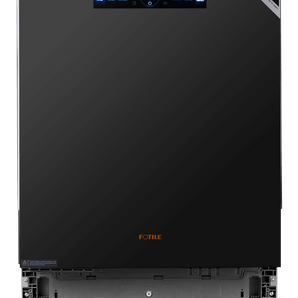
FOTILE's High-Energy Bubble Wash doesn't rely on water pressure alone. Take the FOTILE SD2F-P7 sink dishwasher: its upgraded HydroJet 3.0 technology mixes high-pressure water with countless micro-bubbles. When these bubbles hit the dishes and burst, they create a powerful micro-impact that lifts stubborn grease and dried food residue. This dual cleaning action—chemical (detergent) plus physical (bubble burst)—is something a hand-held cloth simply cannot replicate.
More importantly, a reused cloth easily becomes a breeding ground for bacteria. A dishwasher, by contrast, washes in a sealed chamber with a 360° planetary spray arm, so every drop of water is clean—eliminating the secondary contamination of "washing dishes with a dirty cloth." For Hong Kong families who love wok-fried cooking and greasy dishes, this steady high-pressure wash is far more thorough than daily manual scrubbing.

Question 2: The invisible threat—can hand washing really sterilise?
Raise the standard from "de-greasing" to "disinfection" and the limits of hand washing become obvious. Human skin tolerates water at around 40°C; even with gloves, hand washing rarely exceeds 45°C. At that temperature, common pathogens such as E. coli, Staphylococcus aureus and Salmonella are barely affected.
FOTILE dishwashers, however, use a built-in independent high-speed heating plate to raise water to 100°C steam. This high-temperature sterilisation is no gimmick: authoritative testing confirms a sterilisation rate of 99.9999% against common pathogens including H. pylori and E. coli. The moment you load the dishwasher, you're not just cleaning—you're waging a full-scale battle against micro-organisms.
This matters enormously for families with newborns or young children, whose immune systems are still developing. Paediatricians and microbiologists generally recommend strict sterilisation of feeding utensils. While some overseas guidelines note that ordinary dishwashers at 65°C–70°C achieve "sanitising" rather than "sterilising" levels, FOTILE's 100°C steam combined with baby-care grade certification fills exactly that gap.

What baby-care grade certification really means
"Baby-care grade" is not a marketing phrase used loosely. FOTILE dishwashers have passed the rigorous Technical Specification for Performance Evaluation of Baby-Care Grade Dishwashers, meeting professional standards for high-temperature sterilisation, anti-mould drying and material safety—all suitable for cleaning infant tableware and feeding utensils.
For Hong Kong parents, washing baby bottles, weaning bowls and utensils is often a heavy psychological burden. Hand washing struggles to fully remove milk fat and protein, and damp conditions encourage bacterial growth. After high-temperature washing, FOTILE dishwashers activate dual-circulation hot-air drying or cyclone drying technology, using three-dimensional hot air to rapidly remove moisture from the chamber and dishes. This integrated wash–sterilise–dry process ensures dishes come out dry, warm and sterile—cutting off bacterial growth at the source and giving parents peace of mind when handling anything their baby puts in their mouth.

A practical choice for Hong Kong kitchens: the sink dishwasher
Beyond hygiene, Hong Kong's notoriously tight living space is where FOTILE's design shines. Traditional built-in dishwashers offer large capacity, but many nano-flats simply can't spare the room.
FOTILE's sink dishwasher series tackles this pain point directly. By combining a traditional sink and a dishwasher in one unit, installed in the original sink position, it requires no major cabinet modification—and lets users operate it standing upright, avoiding the back strain of bending over. This three-in-one design (dishwashing, fruit and vegetable washing, seafood washing) streamlines the kitchen workflow: prep vegetables and seafood in the same spot, then load the dishes straight into the wash chamber below. For Hong Kong families who want quality living within limited space, this is more than a dishwasher—it's a complete kitchen space solution.

Conclusion: Give time back to life, leave the cleaning to the professionals
So, is a dishwasher really cleaner than hand washing? From a microbiological standpoint, from the physics of water temperature and pressure, and from the drying process that prevents secondary contamination—the answer is a resounding yes. Hand washing may offer the psychological comfort of "doing it yourself," but when it comes to fighting invisible germs and grease, the high-temperature sterilisation and baby-care grade certification of a FOTILE dishwasher are clearly the better fit for modern health needs.
When you no longer spend your precious post-dinner hours at the sink, and when you know your baby's tableware is cleaned and protected to the strictest standards, you'll realise this machine saves more than effort—it's a long-term investment in your family's health. In humid, rainy Hong Kong, let a FOTILE dishwasher guard the last line of defence in your kitchen—and let every meal end with ease.