
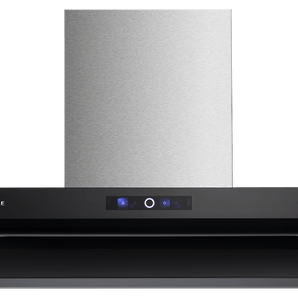
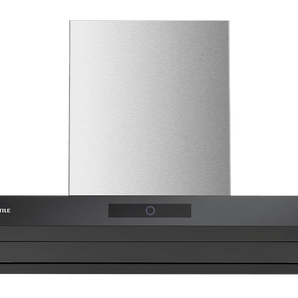
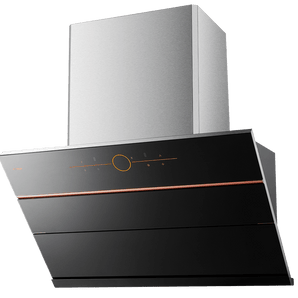
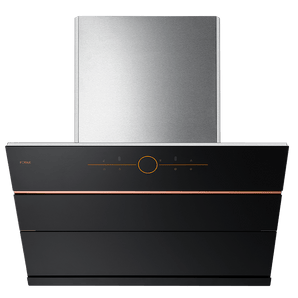

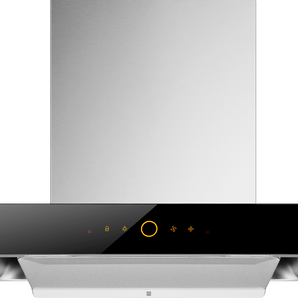






In Hong Kong home kitchens, Chinese-style stir-frying, deep-frying, and high-temperature cooking are very common; these cooking methods generate large amounts of oil fumes, heat, and unpleasant odours in a short period, posing a severe test to the suction power, airflow, static pressure, and exhaust efficiency of range hoods. To effectively cope with heavy oil fumes, a range hood cannot rely solely on its appearance or smoke hood; its core power source—the motor—is the key factor determining its overall extraction and exhaust performance.
FOTILE range hoods widely adopt BLDC brushless direct current variable frequency motors. By replacing the carbon brush structure of traditional brushed motors with electronic control, this type of motor can more precisely adjust speed and output power, achieving a better balance between high airflow, high static pressure, low noise, and energy efficiency. Taking the FOTILE EMG9008 as an example, its BLDC motor can provide a maximum airflow of 1,060 m³/h and a static pressure of 820 Pa; while the ZMG9057-Y can reach a maximum airflow of 1,700 m³/h and a static pressure of 1,450 Pa, making it suitable for home kitchens that frequently stir-fry and generate large amounts of oil fumes.

What is a BLDC brushless direct current variable frequency motor?
BLDC stands for Brushless Direct Current Motor, commonly known in Chinese as a brushless direct current motor or brushless direct current variable frequency motor. Unlike traditional brushed motors, BLDC motors do not rely on carbon brushes and commutators for mechanical commutation, but instead use electronic control systems to precisely adjust the current direction and motor speed.
Simply put, traditional brushed motors rely on contact between carbon brushes and the rotor to change the current direction; BLDC motors replace this mechanical contact with electronic control, thereby reducing carbon brush wear, sparking, and mechanical loss. For range hoods, this means the motor can drive the fan more efficiently and maintain more stable performance during prolonged operation.
Variable frequency refers to the motor's ability to adjust its speed according to the actual oil fume situation. When users are lightly steaming or slow-cooking, the range hood can maintain a lower speed, reducing noise and power consumption; when stir-frying, deep-frying, or generating large amounts of oil fumes, the motor can increase its speed, outputting stronger suction to quickly exhaust oil fumes and unpleasant odours.
How do BLDC motors differ from traditional motors?
| Item | BLDC brushless direct current variable frequency motor | Traditional brushed motor |
|---|---|---|
| Commutation method | Electronic control commutation, brushless structure | Relies on carbon brushes and commutators for mechanical commutation |
| Speed adjustment | Can precisely adjust variable frequency speed according to the amount of oil fumes | Speed range and precision are usually more limited |
| Energy efficiency | Higher conversion efficiency, helping to save energy | Some energy is lost due to friction and loss |
| Noise and vibration | Operates more smoothly, with better noise control | Carbon brush friction may cause more noticeable noise |
| Durability | No carbon brush wear issues, more stable for long-term operation | Carbon brushes are consumable parts and may need periodic replacement |
| Coping with heavy oil fumes | Can output higher airflow and static pressure | Performance under heavy load is more easily limited |
The greatest advantage of the BLDC motor is that it can precisely control speed electronically, allowing the range hood to provide appropriate extraction and exhaust power in different cooking situations. When the amount of oil fumes suddenly increases, such as during high-heat stir-frying or deep-frying, the BLDC motor can quickly increase its speed; when the oil fumes decrease, it can return to a lower speed, avoiding unnecessary noise and energy consumption.

Why can BLDC motors improve range hood suction power?
Many people think that the suction power of a range hood is equal to airflow, but in fact, what really determines whether oil fumes can be effectively extracted and exhausted outdoors also includes static pressure. Airflow represents the amount of air extracted in a unit of time, while static pressure represents the range hood's ability to overcome duct resistance, bends, and exhaust resistance.
Hong Kong residential kitchens are often limited by space, and exhaust pipes may be longer, have more bends, or even need to connect to the building's shared exhaust system. If a range hood has high airflow but insufficient static pressure, oil fumes may still create resistance in the pipes, leading to reduced exhaust efficiency. BLDC motors can stably drive the fan at high speeds, thus helping the range hood maintain stronger exhaust capability when facing duct resistance.
Taking the FOTILE EMG9008 as an example, its maximum airflow is 1,060 m³/h, and its maximum static pressure is 820 Pa; while the ZMG9057-Y can reach a maximum airflow of 1,700 m³/h and a maximum static pressure of 1,450 Pa. These figures reflect the BLDC motor's ability to simultaneously balance airflow and overcome duct resistance when driving the fan, thereby improving overall extraction and exhaust performance.

How do high airflow and high static pressure work together?
The performance of a range hood is not determined by a single specification, but is composed of airflow, static pressure, smoke hood design, oil filtration system, and exhaust ducting. The role of the BLDC motor is to provide a stable and powerful power source for the entire system.
- Airflow (m³/h): Represents the amount of air the range hood can handle per hour. The higher the airflow, the faster it can theoretically remove oil fumes and heat from the kitchen.
- Static pressure (Pa): Represents the range hood's ability to overcome exhaust duct resistance; the higher the static pressure, the easier it is for oil fumes to be smoothly exhausted through longer or more bent pipes.
- BLDC motor: Provides precise variable frequency and stable output, allowing the range hood to adjust its suction according to the amount of oil fumes.
- Turbo boost function: Briefly increases extraction and exhaust power when oil fumes suddenly increase, such as the FOTILE EMG9008 equipped with a 100-second Turbo boost function.
- Smoke hood and oil filtration design: Helps capture smoke, guide airflow, and separate oil, allowing the suction generated by the motor to be more effectively converted into actual exhaust results.
In other words, the BLDC motor does not determine range hood performance alone, but works in coordination with the overall airflow design. Only when a powerful motor, a wide-range smoke hood, an efficient oil filtration structure, and smooth exhaust ducting are combined can oil fumes be quickly captured, extracted, and exhausted outdoors.
Why is it particularly suitable for Hong Kong Chinese-style stir-frying kitchens?
Hong Kong families generally value wok hei and stir-fried flavors. Cooking methods such as high-heat stir-frying, deep-frying, and searing often release large amounts of oil fumes, water vapor, and odors in a short period. If the range hood does not react quickly enough, oil fumes can easily spread to other corners of the kitchen, or even affect the air quality of the open-plan living and dining area.
The advantage of the BLDC variable frequency motor lies in its ability to adjust its speed in real time according to the amount of oil fumes. When the user starts stir-frying, the range hood can increase to a higher wind speed; when the oil fumes decrease, it can lower the speed, maintaining a quieter kitchen environment. This on-demand output mode is more in line with the actual cooking pace than traditional fixed-speed motors.
FOTILE range hoods also combine turbo boost, smart wind speed control, gesture control, and patented airfoil smoke hood designs. Taking the EMG9008 as an example, its 100-second Turbo boost function can increase extraction and exhaust power during peak oil fume periods, combined with a 90cm wide-range smoke capture design, helping to quickly handle the oil fumes generated during stir-frying.
Quietness and energy saving: Another advantage of BLDC
Strong suction does not necessarily mean noise. Since BLDC motors use a brushless design, they reduce mechanical friction between carbon brushes and commutators, thus operating more smoothly and making it easier to control noise with noise reduction technology.
When operating on the low setting, the noise of the FOTILE EMG9008 can be as low as 42 dB; even when operating on the highest setting, the noise is 61 dB. This means that users can maintain a relatively quiet kitchen environment during daily steaming, slow cooking, or light cooking; when handling large amounts of oil fumes, they can switch to a higher wind speed to obtain stronger extraction and exhaust capability.
Frequent stir-frying and deep-frying: Consider models with higher airflow and static pressure, such as the FOTILE ZMG9057-Y, with a maximum airflow of 1,700 m³/h and a maximum static pressure of 1,450 Pa.
BLDC Motor: The Efficient Power Core of Modern Kitchens
The value of a range hood lies not only in its appearance and size, but also in its ability to quickly handle oil fumes, heat, and unpleasant odours during actual cooking. BLDC brushless direct current variable frequency motors provide a stronger and more stable power source for range hoods through electronic control, precise variable frequency, and efficient driving, allowing airflow, static pressure, noise control, and energy efficiency to be balanced simultaneously.
For Hong Kong households, choosing a range hood equipped with a BLDC motor is an important step towards improving kitchen air quality and the cooking experience, especially when dealing with Chinese-style stir-frying, compact kitchens, and increasingly popular open-plan layouts. Through technologies such as BLDC motors, turbo boost, patented smoke hoods, and smart controls, FOTILE provides more efficient smoke and grease extraction solutions for different kitchen spaces and cooking habits.